
What Makes One Piece of Montana Land Worth More Than Another? A Buyer's Guide to Land Value in Paradise Valley
The short answer: Two parcels with the same acreage and the same price per acre can be wildly different investments. Water, access, views, usable terrain, and what you're legally allowed to do with the land are what separate a good purchase from a great one, or a costly mistake.
At Legacy Lands Real Estate in Emigrant, Montana, we help buyers evaluate land the way a rancher would, not the way a listing photo suggests. Here's what actually drives value.
The 8 Factors That Determine Land Value in Park County
Not all acres are created equal.
A 40-acre parcel with Yellowstone River frontage, senior water rights, and year-round road access is a fundamentally different asset than a 40-acre parcel on a steep hillside with no water, a seasonal road, and no power.
Same acreage. Completely different value.
Here are the eight factors our team at Legacy Lands Real Estate evaluates on every property, and what you should be evaluating too.
1. Water
Water is the single most important value driver for Montana land.
It's not close.
What to look for:
River or creek frontage. Yellowstone River frontage in Paradise Valley commands a significant premium. Properties with river access sell for materially more per acre than comparable properties without it. Spring creeks on private land are even rarer and more valuable.
Water rights. Montana operates under prior appropriation, "first in time, first in right." Senior water rights with an early priority date are extremely valuable. They allow irrigation, stock watering, and other beneficial uses that directly affect what you can do with the land.
But here's the critical part:
A water right on paper isn't always a water right in practice. The Statement of Claim may show 320 irrigated acres, but the actual historical use might only support 160. Due diligence on water rights requires more than reading a document, rather it requires verifying the history of actual use.
Well capacity. For domestic use, most rural properties rely on private wells. Well depth, flow rate, and water quality vary dramatically across Park County. A strong well with clean water at 100 feet is a different asset than a marginal well at 400 feet that requires treatment.
Bottom line: Never buy Montana land without fully understanding the water situation. This is where more buyers get burned than anywhere else.
2. Access
Can you actually get to the property?
This sounds obvious. It's not.
Year-round access means a maintained road that's plowed in winter and passable in spring mud season. Properties on county-maintained roads have reliable access. Properties on private roads may or may not, depending on road association agreements and maintenance commitments.
Seasonal access means the road may be impassable for weeks or months. This dramatically limits how you can use the property, and who will buy it from you later.
Landlocked parcels exist in Montana. If the only way to reach a property is across someone else's land, you need a legally recorded access easement. Verbal agreements don't survive ownership changes.
Road frontage affects building site options, emergency response times, and utility connections. Properties with frontage on a state highway or county road have a structural advantage over properties accessed by long private drives.
At Legacy Lands Real Estate in Emigrant, Montana, we check access as part of every property evaluation as opposed to an afterthought.
3. Views
Views matter. But they matter differently than most buyers think.
What adds value:
Unobstructed mountain views, especially of the Absaroka Range, Gallatin Range, or Crazy Mountains from Paradise Valley or the Shields Valley.
Elevated building sites with panoramic sightlines in multiple directions.
River valley views that combine water, meadow, and mountain in a single frame.
What buyers miss:
Views can be lost. If the neighboring parcel is undeveloped, someone can build on it. Unless a conservation easement or zoning restriction protects the sightline, that "forever view" may have an expiration date.
South-facing exposure matters for solar gain, snow melt, and livability. A stunning north-facing slope can be beautiful to look at and miserable to live on in January.
Views without usable land underneath them have limited practical value. A breathtaking 40-acre parcel that's entirely steep hillside may be worth less than a flat 20-acre parcel with moderate views and a perfect building site.
4. Usable Terrain
This is where experience matters most.
Flat, buildable ground is what you need for a home site, septic system, well, outbuildings, and driveway. Many parcels that look impressive on a map are dominated by steep slopes, rocky outcrops, or flood-prone lowlands that severely limit where you can build.
Irrigated hay ground produces income and qualifies for agricultural tax classification. In Park County, parcels with at least 20 acres of productive agricultural land may qualify for significantly reduced property tax assessments, but the land must generate at least $1,500 in gross agricultural income annually.
Pasture quality determines how many horses or livestock the land can support. High-quality native grass pasture in the Yellowstone valley supports more animals per acre than dry bench land above the valley floor.
Timber adds value for privacy screening, wildlife habitat, and aesthetic appeal, but dense timber on a building site means expensive clearing.
Mix matters. The most valuable parcels in Paradise Valley combine several terrain types: irrigated bottomland for production, a bench or rise for a building site with views, and timbered edges for privacy and wildlife.
5. Proximity
Location within the valley dramatically affects price.
Closer to Livingston means easier access to schools, medical care, groceries, and the I-90 corridor to Bozeman. Properties within 15 minutes of Livingston command a premium for convenience.
Upper Paradise Valley (toward Gardiner and Yellowstone National Park) offers more dramatic scenery, larger parcels, and greater privacy, but also longer drives to services and harsher winter conditions.
Shields Valley (northeast of Livingston) is quieter, more agricultural, and generally more affordable per acre. It's increasingly on buyers' radar as Paradise Valley prices climb.
Proximity to public land is a significant value driver for recreational buyers. Properties that border or provide direct access to Forest Service, BLM, or state trust land offer hunting, hiking, and riding opportunities that extend far beyond your property line.
Airport proximity matters for buyers who travel frequently. Bozeman Yellowstone International Airport is roughly 30 minutes from Livingston and over an hour from upper Paradise Valley.
6. Mineral Rights
In Montana, surface rights and mineral rights can be, and often are, owned separately.
This means someone else may hold legal rights to the minerals beneath your land. Mineral severance doesn't affect every parcel, but it's critical to verify through the title report before you buy.
If mineral rights are severed, the mineral owner may have the legal right to access the surface to extract those minerals. This is rare in practice in Paradise Valley, but it's a material risk that serious buyers investigate.
The best scenario: Full mineral rights convey with the surface. This gives you complete control.
The risk scenario: Mineral rights were severed decades ago and are held by a third party or an estate. You may never hear from them—or you might.
Always confirm mineral rights status during due diligence.
7. Utilities and Infrastructure
What's already on the property - and what it costs to bring what isn't.
Power. If the property has existing electrical service, that's a significant advantage. If it doesn't, the cost to extend power lines can range from $15,000 to $100,000+ depending on distance from the nearest transformer.
Internet. Fiber is available in parts of Livingston and along some corridors, but many rural properties rely on satellite or fixed wireless. For remote workers, this is a make-or-break factor.
Septic. An existing, permitted septic system in good working condition saves $15,000–$30,000+ compared to new installation. Soil conditions determine what type of system is feasible, and some soils won't support a standard system at all.
Well. An existing well with a good flow rate and clean water test is a major asset. Drilling a new well in Park County can cost $15,000–$40,000+ depending on depth and conditions.
Fencing. Existing perimeter fence in good condition is worth thousands. New fencing on 20+ acres is a substantial capital expense.
Road and driveway. A property with an existing graded driveway and turnaround is move-in ready. A property that requires a half-mile of new road construction is not.
The gap between "raw land" and "improved land" can easily represent $50,000–$150,000 in infrastructure costs. Factor that into your offer.
8. Future Upside
Smart buyers think about what the land will be worth in 10 or 20 years—not just today.
Factors that protect or increase long-term value:
Proximity to a growing market. Livingston and Park County continue to attract buyers as Bozeman prices push people east. Properties in the path of that demand curve benefit.
Scarcity. There is a finite amount of Yellowstone River frontage. There is a finite amount of irrigated valley land adjacent to public land. Scarcity drives long-term appreciation.
Conservation easements. Counterintuitively, placing a conservation easement can protect value by ensuring the surrounding landscape remains undeveloped. Your neighbor can't subdivide 40 acres into 10 ranchettes if they've placed an easement.
Water rights. Senior water rights will only become more valuable as demand for water in the West increases. They're not making more water.
Agricultural classification. Maintaining ag status keeps property taxes manageable. Losing it can trigger a significant tax increase.
Factors that can erode value:
Poor access that limits future buyers.
Severed mineral rights with uncertain ownership.
Environmental contamination (old mining, fuel storage, etc.).
Changing zoning or subdivision regulations that restrict use.
Deferred maintenance on infrastructure—fencing, wells, septic, roads.
A Real Buyer Story
A buyer from Texas contacted Legacy Lands Real Estate looking for 40-60 acres in Paradise Valley. Budget: $1.2 million.
We showed them two properties:
Property A: 55 acres. Dramatic Absaroka views. Listed at $1.1 million. Steep terrain with one small buildable bench. No water rights. Seasonal access road. No existing infrastructure.
Property B: 42 acres. Good but not dramatic views. Listed at $1.15 million. 15 acres of irrigated hay ground. Year-round county road access. Existing well, septic, and power. Senior water rights. Adjacent to BLM land.
On paper, Property A looked more impressive. In photos, it was stunning.
Property B was the better investment by every measure that matters.
The buyer chose Property B. They built their home the following year, leased the hay ground for income, qualified for agricultural tax classification, and had immediate access to thousands of acres of public land for hunting and riding.
Property A is still on the market.
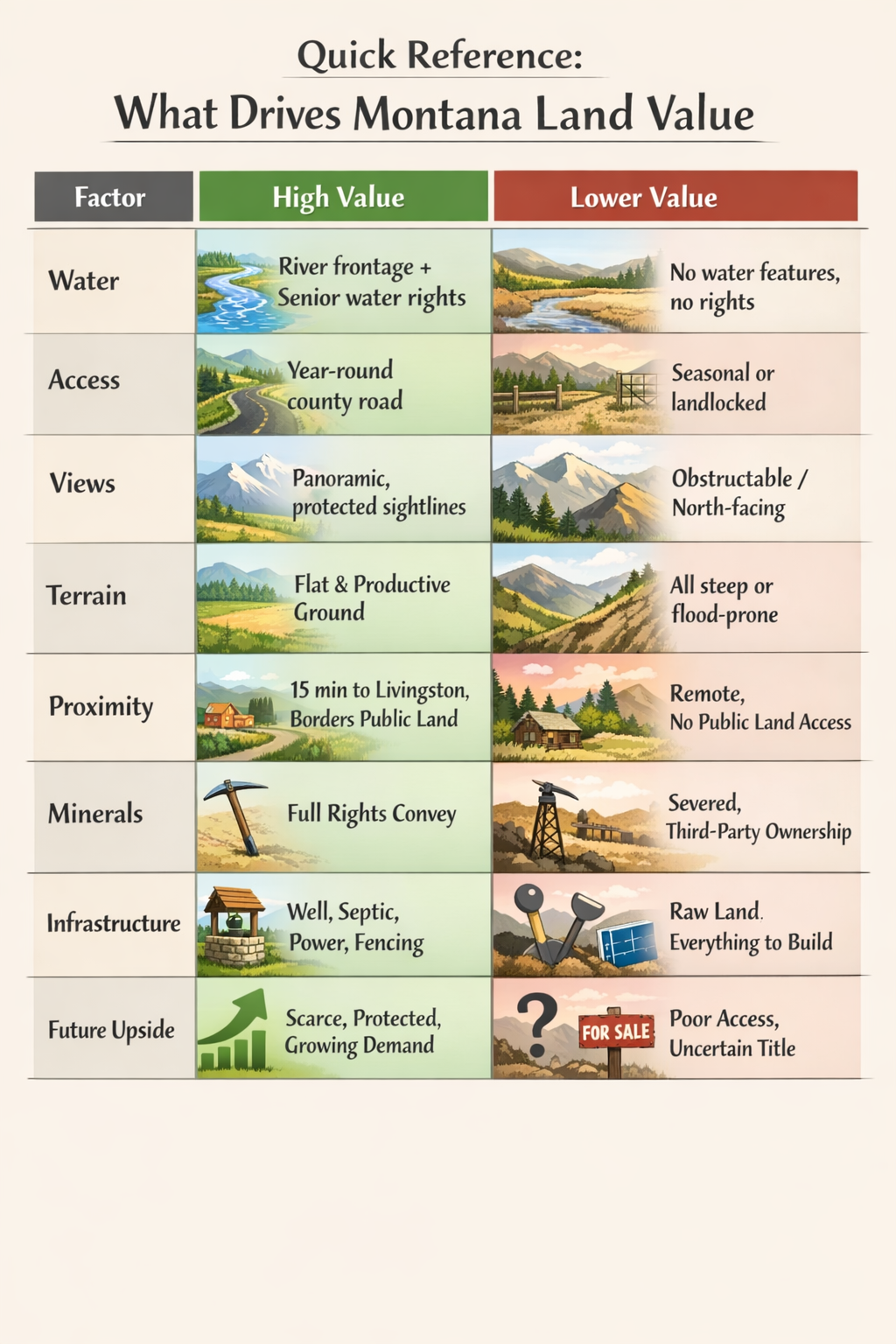
Quick Reference: What Drives Montana Land Value
The Bottom Line
The question isn't "how much per acre?"
The question is "what am I actually getting for that price?"
Two properties at $25,000 per acre can represent completely different investments. The one with water, access, usable terrain, and infrastructure is worth every dollar. The one without them may cost you twice the purchase price before you can use it.
Work with a team that evaluates land the way it should be evaluated by what it can do, not just what it looks like.
Next Steps
If you're evaluating land in Paradise Valley, Livingston, or Park County:
Ask our team to walk you through the value factors on any property you're considering.
Request a water rights review and access assessment before you make an offer.
Get an honest comparison of what raw land versus improved land will actually cost you.
Legacy Lands Real Estate 204 Railroad Lane Emigrant, MT 59027 (406) 848-9400 legacylandsllc.com
Frequently Asked Questions
What's the most important factor in Montana land value?
Water. River frontage, creek access, senior water rights, and reliable well capacity are the single biggest drivers of land value in Park County and Paradise Valley. A property with strong water is a fundamentally different asset than one without it.
How much does it cost to develop raw land in Montana?
Infrastructure costs on raw land such as well, septic, power, road, and fencing can easily total $50,000 to $150,000+ depending on distance from utilities and soil conditions. Always factor development costs into your offer on unimproved parcels.
Do mineral rights always come with the land in Montana?
No. Surface and mineral rights can be severed and owned separately. Always verify mineral rights status through the title report during due diligence. Severed mineral rights can affect your ability to control what happens on and under your land.
Is land near Livingston a good long-term investment?
Park County benefits from proximity to a growing Bozeman market, finite supply of high-quality valley land, and steady demand from lifestyle and legacy buyers. Properties with strong water, year-round access, and usable terrain have historically appreciated well. Scarcity of Yellowstone River frontage and irrigated land supports long-term value.
Legacy Lands Real Estate is a Montana brokerage rooted in Paradise Valley, specializing in ranch, land, and mountain properties across Park County and southwest Montana. Our team of brokers and agents — many of them multi-generational Montanans — brings firsthand experience in ranching, land stewardship, and rural property to every transaction. Every piece of land has its own history. We help buyers and sellers find the right match. Contact us at (406) 848-9400 or visit legacylandsllc.com.