
What Can You Actually Do With Montana Land? A Buyer's Guide to Land Use in Paradise Valley and Park County
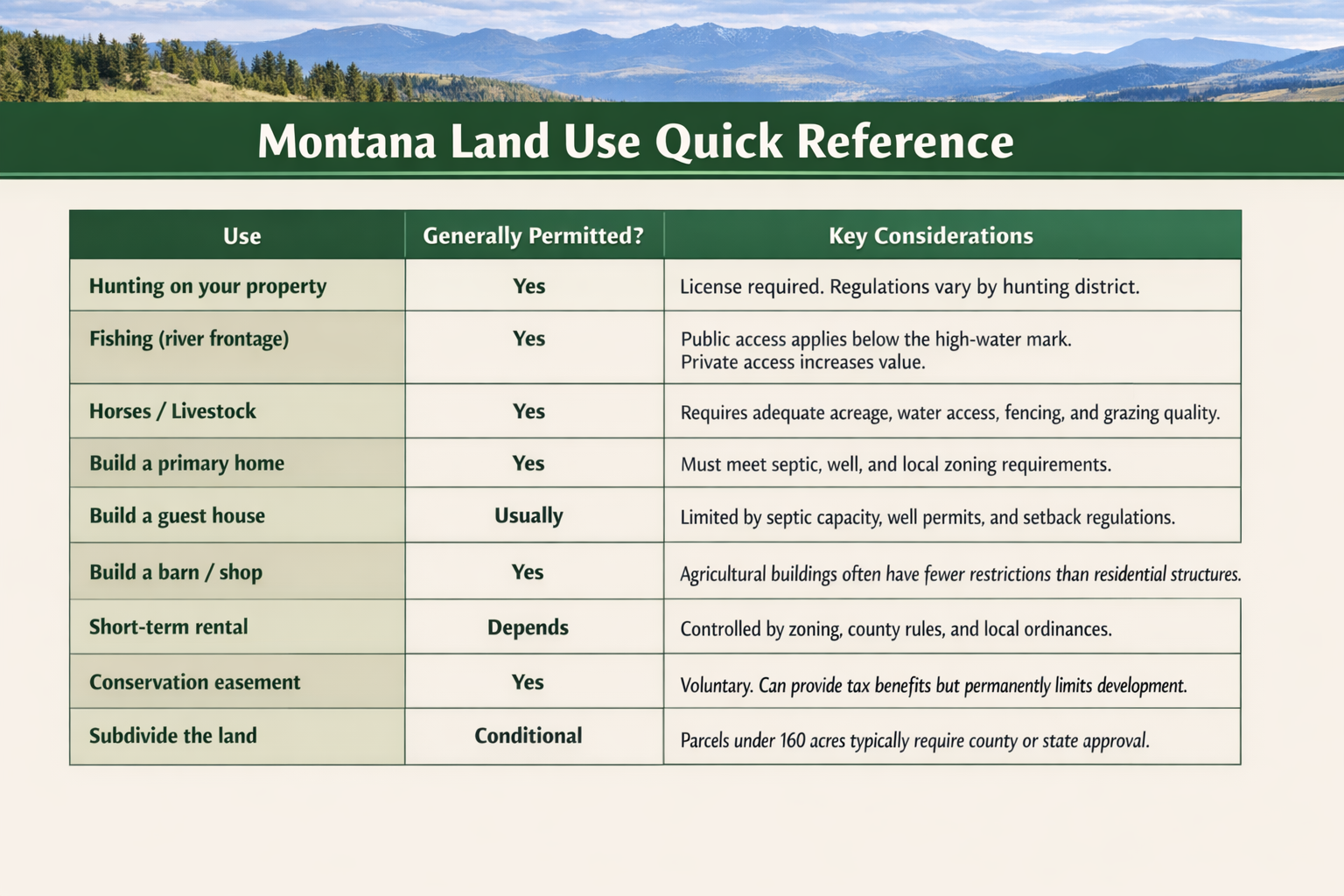
The short answer: More than most people realize, but with important rules you need to understand before you buy. Hunting, fishing, horses, guest houses, short-term rentals, conservation easements, and multiple structures are all possible on the right property. But "possible" and "permitted" aren't always the same thing.
At Legacy Lands Real Estate in Emigrant, Montana, land use is one of the first conversations we have with buyers. Not because it's complicated, but because the wrong assumptions can cost you years and thousands of dollars.
Here's what you need to know.
Why This Question Matters More Than Most Buyers Realize
Buyers fall in love with a view.
Then they ask: "Can I build a barn here? Can I run horses? Can I put a guest cabin on this for Airbnb?"
Sometimes the answer is yes.
Sometimes it's no, and the reason isn't obvious until you're deep into due diligence.
Montana is one of the least restrictive states in the country when it comes to land use. But "least restrictive" doesn't mean "no rules." Park County has zoning districts, septic and well requirements, floodplain regulations, and subdivision laws that all affect what you can build and how you can use your property.
The buyers who have the best experience are the ones who understand the rules before they make an offer, not after.
Hunting and Fishing Access
This is the number one question from out-of-state buyers looking at Paradise Valley property.
Hunting:
Montana offers some of the best elk, deer, antelope, and upland bird hunting in the Lower 48. If your property has enough acreage and the right terrain, you can hunt on your own land.
But there are important details:
You still need a Montana hunting license. Landowner tags exist, but the process and availability vary by species and hunting district.
Wildlife doesn't respect property lines. Access to adjacent public land such as BLM, Forest Service, state trust land, can dramatically increase the hunting value of a property.
Some properties border or are near wilderness areas, national forest, or wildlife management areas. Legacy Lands Real Estate in Emigrant, Montana can help you evaluate adjacency and access as part of the property search.
Fishing:
The Yellowstone River corridor is world-class fly fishing. Properties with river frontage or creek access offer direct, private fishing opportunities.
Montana law allows public access to rivers and streams below the ordinary high-water mark. This means the river itself is public—but access points are controlled by landowners.
Owning river-front property gives you private access that most anglers can only dream about.
Spring creeks on private land are particularly valuable. They're not subject to the same public access rules as navigable rivers.
Horses and Livestock
Paradise Valley and the Shields Valley are horse country. Many properties are set up for, or can be adapted to, equestrian use.
What to look for:
Adequate acreage. Most buyers find that 5 to 20 acres supports horses comfortably, depending on grazing quality and hay availability.
Fencing. Existing fence in good condition saves thousands. New fence on 20 acres can run $15,000–$30,000+.
Water. Horses need reliable, year-round water. A property with a well, creek, or irrigation rights is essential.
Outbuildings. Barns, loafing sheds, and tack rooms. Some properties have them. Others require new construction, which brings us to the next section.
Livestock considerations:
Cattle, sheep, and other livestock are common in Park County. Agricultural use can qualify your property for lower tax assessments, which significantly reduces annual property tax obligations.
If you're running livestock, you'll want to understand grazing leases, fencing obligations, and water rights. Our team at Legacy Lands Real Estate includes multi-generational ranchers who can walk you through the operational realities.
Building Multiple Structures
This is where buyers get surprised, sometimes pleasantly, sometimes not.
The good news:
Montana is generally permissive about building on rural land. If your property is outside city limits, outside a zoning district, and large enough to meet septic and well requirements, you typically have significant flexibility.
You can often build:
A primary residence.
A detached garage or shop.
A barn or agricultural building.
A guest house or caretaker's quarters.
The rules that matter:
Septic capacity. Every habitable structure needs an approved septic system or connection. Park County Environmental Health reviews and permits all septic installations.
Well permits. Additional structures with plumbing may require additional well capacity or permitting through the Montana DNRC.
Zoning. Park County has 7 zoning districts. If your property falls within one, there are setback, density, and use restrictions. Properties outside zoning districts have more flexibility, but still must comply with county and state regulations.
Subdivision rules. If you're building structures for lease or rent (not personal use), Montana's subdivision and platting laws may apply. The first 3 buildings for lease or rent on a single tract generally require only sanitation review. After that, additional review by the county commission may be needed.
Floodplain. Properties near the Yellowstone River or tributaries may have floodplain restrictions that limit where and what you can build.
Bottom line: Before you plan your compound, talk to Park County Planning (406-222-4102) and work with a broker who understands these regulations. At Legacy Lands Real Estate, we help buyers navigate this before the offer—not after the surprise.
Short-Term Rentals
"Can I Airbnb the guest cabin?"
This is one of the most common questions we hear. The answer depends on where the property is located.
Outside Livingston city limits:
Park County does not currently have a county-wide short-term rental ordinance. Properties outside city limits and outside zoning districts generally have more flexibility for short-term rental use.
However, if the property falls within one of Park County's 7 zoning districts, including the Paradise Valley District, short-term rental use may be restricted or require a conditional use permit.
Inside Livingston city limits:
The City of Livingston has its own regulations governing short-term rentals. Check current ordinances before assuming a property qualifies.
Tax implications:
Short-term rental income is taxable. Montana also collects a lodging facility use tax (bed tax). You'll need to register and remit this tax if you're operating a rental.
Important caveat:
Short-term rental regulations are evolving across Montana. What's permitted today may change. If rental income is part of your investment thesis, verify current rules and consider how potential regulation could affect your plans.
Conservation Easements
This is where land ownership intersects with legacy planning, and it's one of the most powerful tools available to Montana landowners.
What it is:
A conservation easement is a voluntary legal agreement between a landowner and a land trust or government agency that permanently limits development on the property. You keep ownership. You keep using the land. You simply agree not to subdivide or develop it beyond agreed-upon terms.
Why buyers care:
Montana leads the nation in conservation easements. Over 2,500 farmers and ranchers have placed easements on their properties, covering more than 3 million acres statewide.
The reasons are practical:
Tax benefits. Donating a conservation easement can qualify as a charitable contribution. Landowners can deduct the value against 50% of adjusted gross income, with a 15-year carryforward. Qualified farmers and ranchers can deduct against 100% of AGI.
Estate planning. An easement reduces the appraised value of the property, which can lower or eliminate estate taxes. An additional estate tax exclusion of up to $500,000 may apply.
Property tax stability. Under Montana law, property taxes on agricultural land are calculated based on current use. An easement that prevents subdivision generally doesn't increase assessed value.
Legacy preservation. If you're buying land that you want to keep in the family for generations, a conservation easement ensures it won't be subdivided or developed after you're gone.
What you keep:
You still own the land. You still manage it. You can still ranch, farm, hunt, fish, and live on it. Agricultural operations continue. The easement limits subdivision and commercial development, not daily use.
Who holds the easement:
The Montana Land Reliance, Gallatin Valley Land Trust, and The Nature Conservancy are among the most active land trusts in the Paradise Valley and Park County area.
Is it right for every property?
No. Conservation easements are permanent. They reduce future development potential, which affects resale value. They're best suited for buyers who are committed to long-term ownership and land stewardship.
At Legacy Lands Real Estate in Emigrant, Montana, we work with buyers who are thinking generationally—not transactionally. Conservation easements are one of the tools we discuss as part of that conversation.
A Real Buyer Story
A family from Colorado purchased 80 acres in Paradise Valley through Legacy Lands Real Estate.
Their plan:
Build a primary home.
Add a guest cabin for visiting family.
Run 6 horses.
Eventually explore a conservation easement.
During due diligence, we identified that the property sat partially within a zoning district that required setback adjustments for the guest cabin location. We also discovered that the existing well had capacity limitations that would affect where they could place the second structure.
We worked with Park County Planning, a local well driller, and a septic engineer before closing.
Result: They adjusted their site plan, got permits approved, and closed on schedule. The guest cabin went up the following spring. The horses arrived in June.
Two years later, they began conversations with the Montana Land Reliance about a conservation easement.
Their words:
"We would have made expensive mistakes without a team that understood how the land actually works."
The Bottom Line
Montana land gives you more freedom than almost any state in the country.
But freedom isn't the same as no rules.
The buyers who get the most out of their property are the ones who understand what's possible before they buy—not the ones who find out what's restricted after they close.
Work with a team that knows the land, the regulations, and the real-world realities of owning rural property in Park County.
Next Steps
If you're looking at land in Paradise Valley, Livingston, or southwest Montana and want clarity on what you can actually do with it:
Talk to our team about specific properties and their use potential.
Ask us about zoning, septic, well, and building considerations for any parcel.
Explore whether a conservation easement fits your long-term ownership goals.
Legacy Lands Real Estate 204 Railroad Lane Emigrant, MT 59027 (406) 848-9400 legacylandsllc.com
Frequently Asked Questions
Can I hunt on my own property in Montana?
Yes, but you still need a valid Montana hunting license. Landowner tags are available for some species. The hunting value of a property increases significantly when it borders or provides access to public land such as national forest or BLM.
Can I build a guest house on rural Montana land?
In most cases, yes, but it depends on septic capacity, well permits, zoning district restrictions, and setback requirements. Park County Planning reviews all habitable structures. Get clarity before you finalize your site plan.
What are the tax benefits of a conservation easement in Montana?
Donating a conservation easement can qualify as a charitable deduction against 50% of adjusted gross income (100% for qualified farmers and ranchers), with a 15-year carryforward. Easements can also reduce estate taxes by lowering appraised property value, with an additional exclusion of up to $500,000.
Can I run a short-term rental on rural Montana property?
It depends on location and zoning. Properties outside city limits and outside zoning districts generally have more flexibility. Properties within Park County's zoning districts - including the Paradise Valley District - may require conditional use permits or may restrict short-term rentals entirely. Regulations are evolving, so verify current rules before buying.
Legacy Lands Real Estate is a Montana brokerage rooted in Paradise Valley, specializing in ranch, land, and mountain properties across Park County and southwest Montana. Our team of brokers and agents — many of them multi-generational Montanans — brings firsthand experience in ranching, land stewardship, and rural property to every transaction. Every piece of land has its own history. We help buyers and sellers find the right match. Contact us at (406) 848-9400 or visit legacylandsllc.com.