
What Buyers Should Know About Cinnabar Basin, Montana Real Estate
A guide to buying property in one of Paradise Valley's rarest corridors - From the Brokerage who has sold land here for decades.
People looking at Cinnabar Basin real estate are not casually browsing Montana property.
They are looking for something specific. Privacy. Wildlife. Large acreage near Yellowstone. A piece of ground that still feels the way Paradise Valley felt forty years ago.
Cinnabar Basin sits just north of Yellowstone National Park, near the small communities of Corwin Springs and Gardiner. Properties here rarely come up for sale. When one does, buyers who understand the corridor tend to move quickly, because the next comparable property may not appear for two or three years.
This guide covers what a buyer should know before purchasing in Cinnabar Basin, including:
Where the corridor sits and how to get there
What makes it different from the rest of Paradise Valley
Land values and the price range to expect
Water rights, mineral rights, and creek frontage
Wildlife and hunting considerations
Conservation easements
Access, roads, utilities, and infrastructure
Who buys here and what they are after
A property currently available in the corridor
Everything below comes from working in this country, not from a brochure.
Key Takeaways
If you only read this far, here is what matters most about buying property in Cinnabar Basin:
The corridor sits about 30 minutes from Yellowstone's North Entrance, in Park County, Montana, near Gardiner and Corwin Springs.
Most parcels trace back to original ranching families from the late 1800s and rarely come up for sale. When one does, the buyer pool moves quickly.
Senior water rights matter more here than in most of Montana. Many basin properties carry rights filed in the 1800s, governed by the doctrine of "first in time, first in right."
Conservation easements are common in this corridor, often through Gallatin Valley Land Trust's Northern Yellowstone Open Lands initiative. Eased properties typically retain or increase value rather than lose it.
Improved properties in the basin generally range from $3M to $10M and beyond. Legacy Lands currently represents the Cinnabar Basin Lodge at $8,499,000, an 86-acre property with a 6,400+ square foot main residence and three additional cabins.
Where Is Cinnabar Basin in Montana?
Cinnabar Basin sits north of Yellowstone National Park, in Park County, Montana. The basin is part of the broader Paradise Valley corridor, accessible from the small communities of Corwin Springs and Gardiner.
From Livingston, the route is straightforward. Head south on Highway 89 through the heart of Paradise Valley, with the Absaroka Range on the east and the Gallatin Range on the west. The drive south takes a little over an hour to reach the Cinnabar Basin corridor. The Yellowstone River runs through the valley below.
The name comes from the original town of Cinnabar, which existed from 1883 to 1903. The Northern Pacific Railroad built a spur line from Livingston to Cinnabar to bring tourists to Yellowstone. Visitors got off the train at Cinnabar and rode stagecoach the last three miles to the Park's North Entrance. When the rail line was extended into Gardiner in 1903, the town of Cinnabar was abandoned. Buildings were moved to Gardiner. The depot itself was loaded onto a train and shipped down the line. Today the original townsite sits inside the current Park boundary, marked only by a few foundation depressions in the sagebrush.
The basin that bears the town's name is on private land, north and west of where the town stood. It is not the same place. But it shares the same gateway-to-Yellowstone position that made the original Cinnabar matter in the first place.
How Far Is Cinnabar Basin From Yellowstone National Park?
Yellowstone proximity is the single most-asked question about this corridor, and it is the reason most buyers are here.
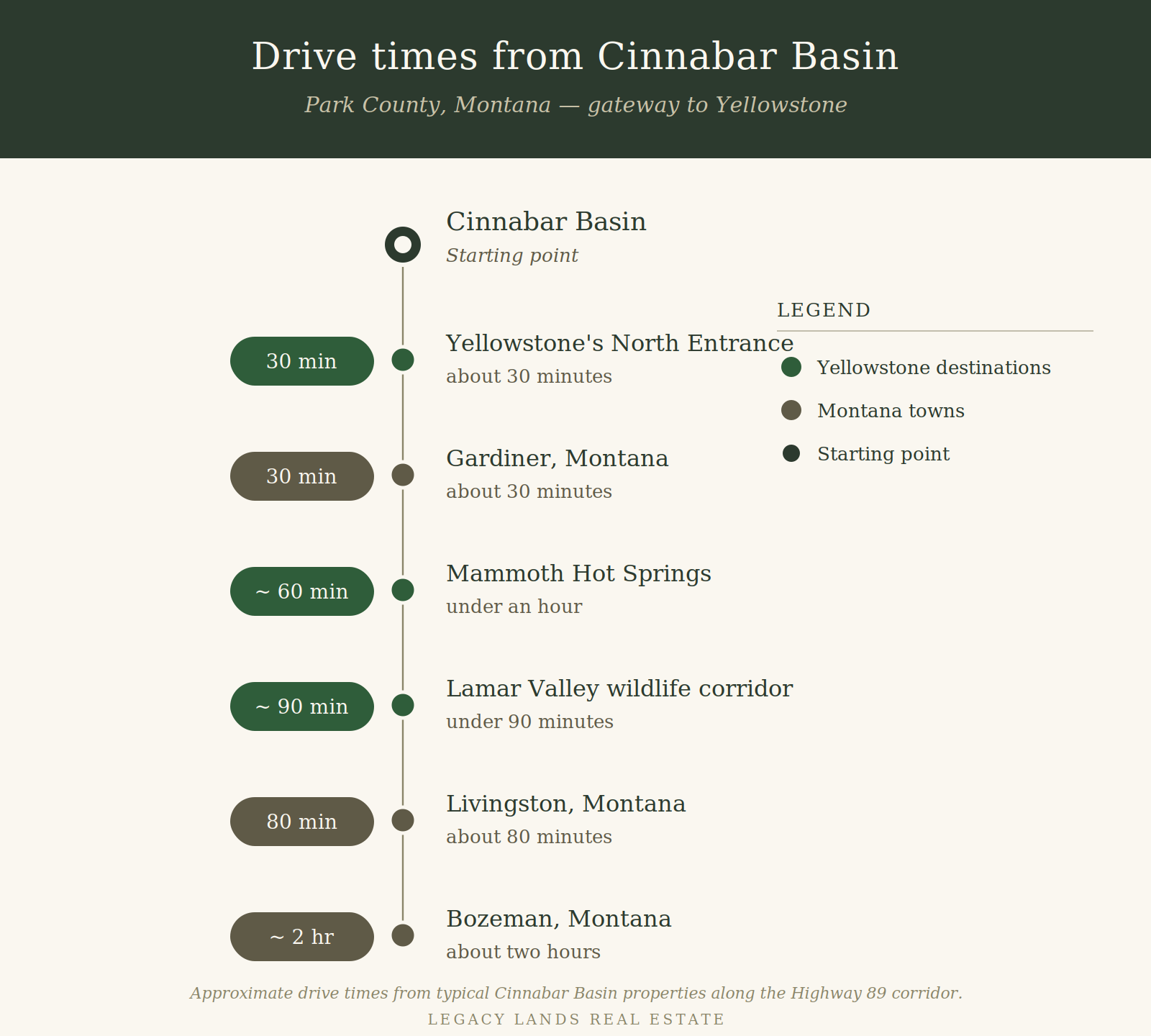
Drive times from Cinnabar Basin to Yellowstone's North Entrance, Gardiner, Mammoth Hot Springs, Lamar Valley, Livingston, and Bozeman
From most properties in the basin, Yellowstone's North Entrance and Gardiner are both about 30 minutes away. Mammoth Hot Springs is under an hour. The Lamar Valley wildlife corridor, one of the best wolf and bison viewing stretches in the lower 48, is under 90 minutes. Livingston sits about 80 minutes north for groceries and town errands, and Bozeman is roughly two hours away for the airport.
Few private properties anywhere in the country sit this close to a national park of Yellowstone's caliber. For buyers who spend serious time in the Park, that proximity is not a feature. It is the point.
What Makes Cinnabar Basin Different From the Rest of Paradise Valley?
A few things separate this corridor from the broader valley.
Yellowstone proximity. Cinnabar Basin is one of the closest private-land corridors to the Park's northern entrance. Properties further north in Paradise Valley are beautiful country in their own right, but they are an hour or more further from the Park. That distance changes the experience.
Wildlife volume. The basin sits inside a major wildlife corridor running north out of Yellowstone. Elk migrations move through the corridor seasonally. Resident populations include mule deer, white-tailed deer, bighorn sheep, moose, antelope, black bear, grizzly bear, and mountain lion. Wolves move through. The corridor is also one of the rare places in the lower 48 where bison occasionally wander onto private land. Many properties here see wildlife on the ground every single day, not as an occasional event.
Low density and original family ownership. This is not subdivision country. Most parcels in the basin trace back to homestead patents from the late 1800s. Many have changed hands only a handful of times since the original ranching families settled the valley. Ownership turnover is low. Large parcels stay in families for generations.
Public land borders. Most properties in the basin border substantial blocks of Custer Gallatin National Forest, BLM land, or Park land. A buyer might own 80 deeded acres while effectively having access to surrounding public land they can walk from the front door without crossing a fence.
Quietness. Cinnabar Basin is not a tourist corridor. The traffic on Highway 89 is largely seasonal, and the basin sits off the main road. Most days, the loudest sound on a property in the basin is the creek.
Is Cinnabar Basin a Good Place to Buy Property in Montana?
For the right buyer, yes. For the wrong buyer, no.
Cinnabar Basin is the right corridor for someone looking for:
Long-term land ownership they intend to pass to children
Direct daily presence of Yellowstone wildlife
A base camp on the right side of the Park gate
Privacy and distance from resort-density development
A piece of Montana that is unlikely to look very different in 20 years
It is not the right corridor for someone looking for:
Short-term appreciation flips
Dense neighborhood living or walkable amenities
Resort-style infrastructure, golf, or social calendars
A property they only intend to visit a handful of times a year
Most buyers who close on properties here are choosing this corridor specifically. They are not comparing it to a Bozeman house or a Big Sky condo. They have already decided what they want, and Cinnabar Basin is one of the few places that delivers it.
The Historical Context That Matters for Buyers
Cinnabar Basin's land has a long history of single-family ownership. Many parcels in the basin trace back to homestead patents from the late 1800s. The first ranching families to settle Paradise Valley arrived during the same period the Northern Pacific Railroad was building toward Yellowstone, and the families that stayed often remained on the same ground for four and five generations.
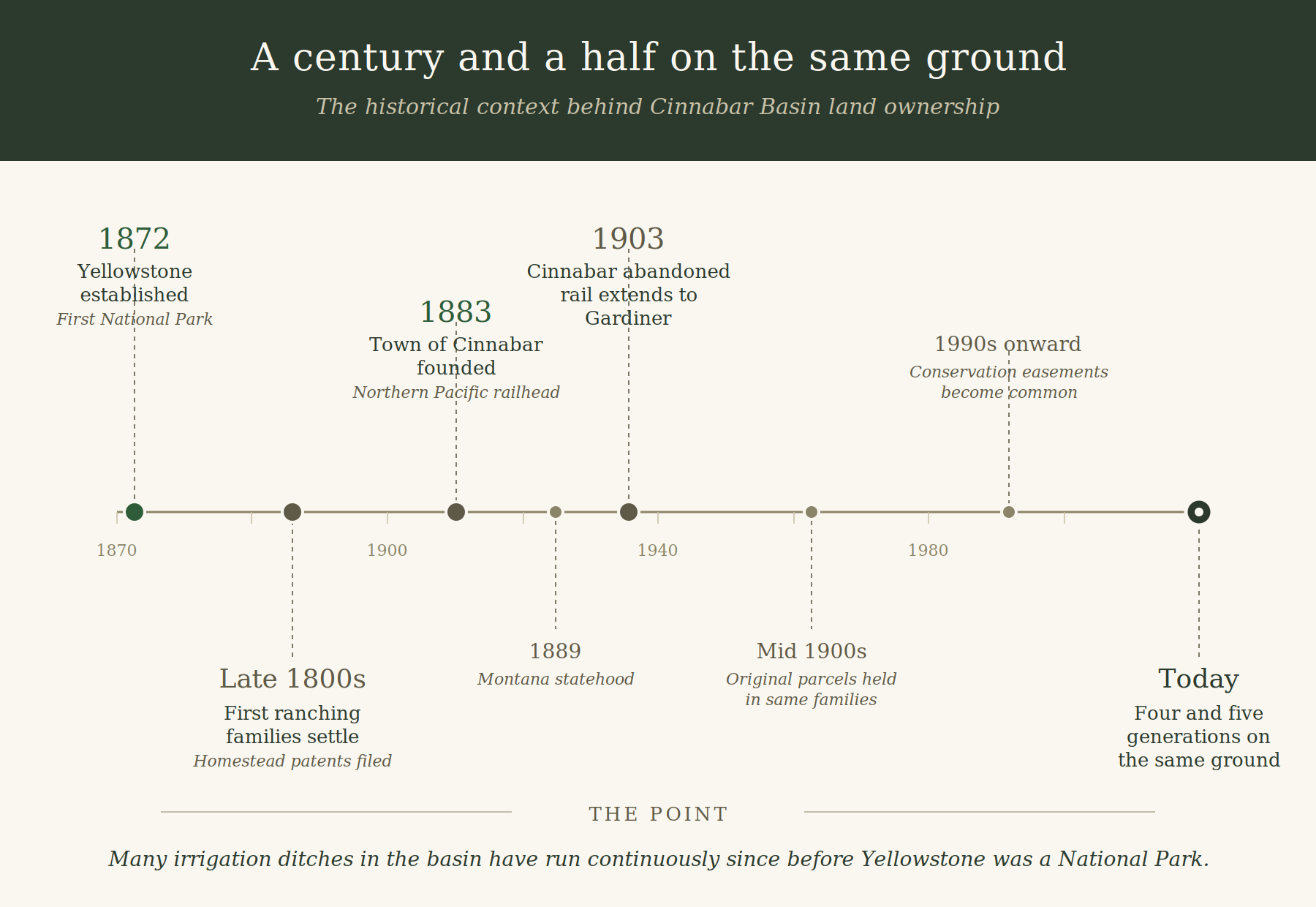
Timeline showing the history of Cinnabar Basin and Paradise Valley land ownership from the 1870s through today, including Yellowstone's 1872 establishment, the late-1800s homestead settlements, the brief life of the town of Cinnabar from 1883 to 1903, and the present-day reality of land still held in original ranching families
What that means for a buyer today:
Most properties here come with a story. Original cabins. Hand-cut log structures. Senior water rights filed in the 1800s. Irrigation ditches that have been running since before Yellowstone was a National Park. These are not staged Western details. They are working features of the land that have been there longer than the State of Montana.
Buyers who appreciate this history tend to be the ones who steward the land well after they own it. Sellers of these properties tend to be careful about who they hand the land to. The brokerage relationship matters here. So does the buyer's understanding of what the land actually is.
What Properties Cost in Cinnabar Basin
Cinnabar Basin properties trade in a higher range than typical Paradise Valley acreage, for two reasons: proximity to Yellowstone, and limited supply.
Bare-land parcels in the basin generally fall in the multi-million-dollar range, depending on size, water access, viewshed, and wildlife corridor placement.
Improved properties, meaning a parcel with a primary residence, water rights, and outbuildings, have typically started in the $3 to $5 million range in recent years. Properties with significant acreage, substantial improvements, and direct creek frontage can climb into the $8 to $10 million range and beyond.
For perspective: a residential lot in Bozeman might cost a fraction of a Cinnabar Basin parcel of the same acreage. A working ranch in eastern Montana might cost less per acre than a recreational parcel here. The pricing in this corridor reflects what the location is, not what the land produces. Buyers are paying for proximity, privacy, and long-term scarcity, not for cattle yield or hay tonnage.
Water Rights in Cinnabar Basin
Water in Cinnabar Basin comes from the creeks and springs that drain the surrounding mountains. Most older parcels in the basin have decreed water rights tied to specific points of diversion, usually irrigation ditches or stock-water sources, that date back to the original ranching settlement of the valley.
A few things every buyer should understand:
Senior rights matter in Montana.The state follows the doctrine of "first in time, first in right," which means the oldest water rights have the strongest legal claim during shortage years. Properties in Cinnabar Basin frequently carry senior rights filed in the 1800s, which is meaningful in a state where many water rights are decades younger.
Under Montana law (MCA 85-2-403), water rights that are appurtenant to the land pass automatically with the sale unless they are specifically reserved or exempted. Confirm the rights in the contract anyway, and file the DNRC ownership update after closing. Verify this before closing. The Montana Department of Natural Resources and Conservation maintains the Water Rights Query System, and a competent broker will pull the records as part of due diligence.
Creek frontage is a different question from creek rights. Owning land along a creek does not mean you own the right to take water from it. These are two separate property interests, and both matter.
Adjudication status. Montana is currently working through a statewide adjudication of pre-1973 water claims, which can affect the legal status of older water rights. Verify the adjudication status of any property's water rights as part of due diligence.
A property with a year-round creek running through it, decreed senior water rights, and the legal authority to use that water for irrigation, stock, and domestic purposes is a different property than one with creek frontage alone. Buyers need to know which they are looking at.
Wildlife and Hunting
Cinnabar Basin sits inside Montana Hunting District 313 in the northern Yellowstone corridor.
Hunting on private land in the district is governed by the same rules as the rest of Montana: the landowner controls hunting access on their own property. Many basin properties qualify for resident or non-resident hunting under Montana Fish, Wildlife & Parks rules.
Owners of property in Cinnabar Basin can:
Hunt their own land if it qualifies under MFWP rules
Lease hunting rights to others
Restrict hunting entirely
Place the property in wildlife conservation programs
That said, most Cinnabar Basin buyers are after the daily presence of wildlife, not the harvest. Watching elk migrate across the property in October matters more to most buyers than the kill itself. The corridor's wildlife volume is the draw, regardless of whether the new owner ever picks up a rifle.
Access, Roads, and Infrastructure
A few practical realities of buying in Cinnabar Basin:
Roads and easements. Most properties are accessed off Highway 89 via county roads or private easements. County roads are maintained year-round. Private roads typically have shared maintenance arrangements among property owners. Verify the access easement language in the title before closing. A property without legal, deeded access is a different property than one with it.
Utilities. Most improved properties in the basin have grid power. Some remote parcels rely on solar with generator backup. Internet is increasingly available through Starlink and fixed wireless. Cellular service is variable depending on terrain.
Fire and EMS. The basin is served by volunteer fire response and EMS out of Gardiner. Wildfire is a real consideration in this corridor. Defensible space around structures, fire-resistant building materials, and on-site water storage for fire suppression are standard considerations for any new construction or major renovation.
Wells and septic. Properties are typically on private well water and septic systems. A pre-purchase well test (water quality and recovery rate) and septic inspection are non-optional in this corridor.
Insurance. Wildfire insurance has tightened across western Montana. Verify availability before closing, not after.
Conservation Easements
A meaningful share of Paradise Valley land, including in the broader Cinnabar Basin area, is held under conservation easements. These are voluntary legal agreements between a landowner and a qualified land trust that restrict certain types of development on a property in exchange for tax benefits.
If a property carries an easement, a buyer needs to understand:
The terms run with the land permanently. Future owners are bound by them.
Common restrictions include limits on subdivision, commercial development, and certain types of structure construction.
Easements typically do not affect personal residential use, agricultural operations, or hunting.
Most owners of eased land find the restrictions consistent with how they wanted to use the land anyway.
For Cinnabar Basin specifically, conservation easements are common because the corridor's wildlife values make it a priority for organizations working in this part of Montana. Gallatin Valley Land Trust, based in Bozeman with a Livingston office, has been particularly active in Park County. GVLT runs a dedicated initiative called Northern Yellowstone Open Lands, focused on conservation in the corridor from the Shields River headwaters to the northern gateway of Yellowstone, which puts Cinnabar Basin squarely in their service area. They have completed 21 conservation easements in Park County to date, protecting over 20,000 acres. Other organizations active in Paradise Valley conservation include the Montana Land Reliance, The Nature Conservancy in Montana, and research-focused groups like the Property and Environment Research Center. A conservation-eased property in this basin is often more valuable, not less, because the easement protects the same things a buyer is paying for.
What Type of Buyers Purchase Property in Cinnabar Basin?
The buyer pool for Cinnabar Basin is small and specific. In our experience working in this corridor, the buyers who close on properties here generally fall into a few overlapping types:
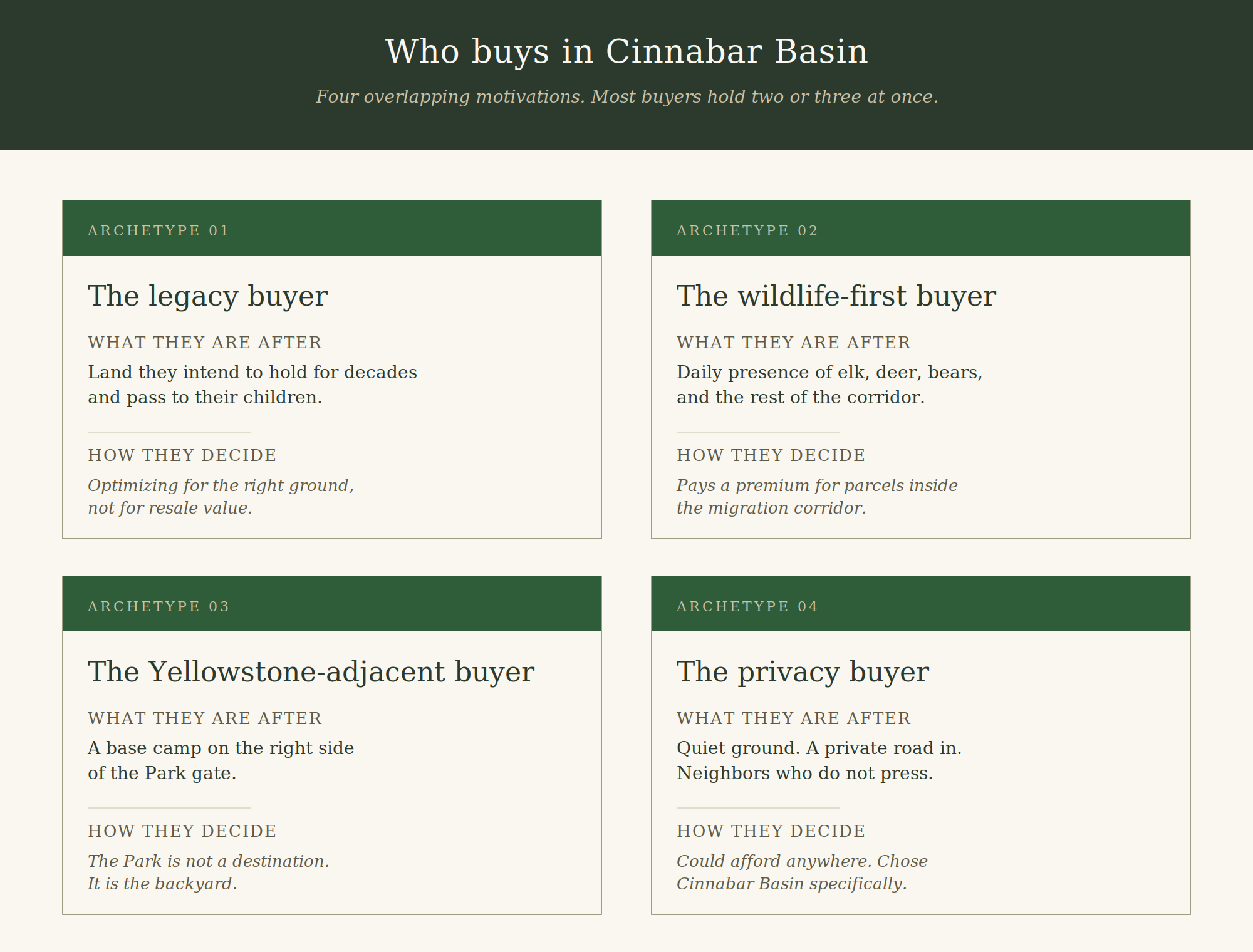
Four buyer archetypes for Cinnabar Basin properties: the legacy buyer who is buying land to hold for decades and pass to children, the wildlife-first buyer who wants daily presence of elk and deer and bears, the Yellowstone-adjacent buyer who treats the Park as a backyard, and the privacy buyer who could afford anywhere and chose Cinnabar Basin specifically
These buyers are not interchangeable. The right property for one is often the wrong property for another. A good broker reads the buyer well before showing them property.
A Property Currently Available in Cinnabar Basin
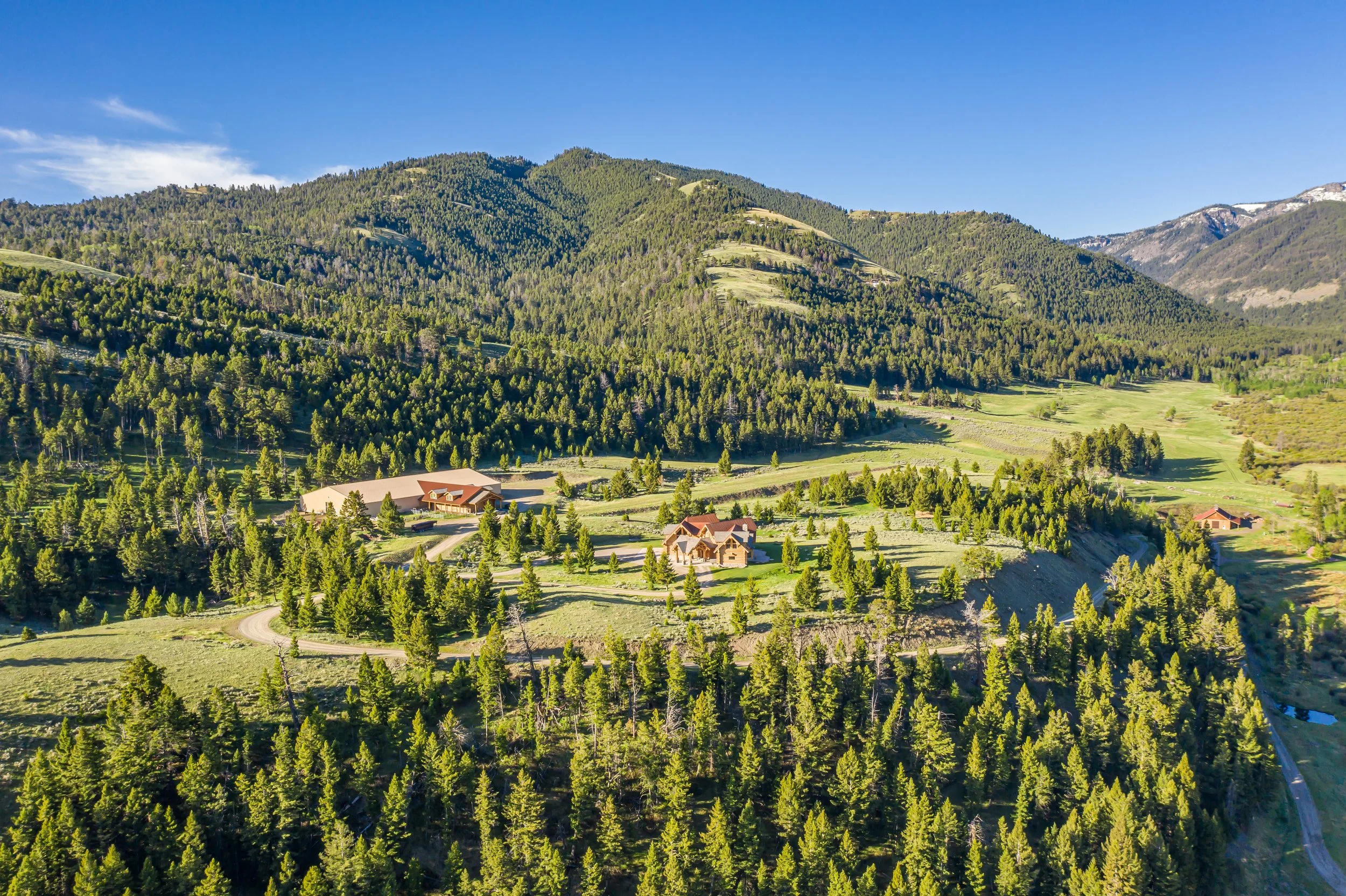
Cinnabar Basin Lodge - one of the most beautiful private properties in Cinnabar Basin including multiple cabins, a 6,400 square foot log lodge, and full horse facilities.
Properties in this corridor come up rarely. As of this writing, Legacy Lands represents an 86-acre property in Cinnabar Basin that illustrates much of what makes this corridor distinctive.
The property is the Cinnabar Basin Lodge, originally settled by one of the first ranching families to arrive in Paradise Valley in the 1800s. The 86 deeded acres include a year-round creek running through the property and direct daily wildlife traffic, including deer, elk, bighorn sheep, and bison.
The improvements are substantial. The main residence is a custom log home of more than 6,400 square feet, with a grand entrance opening into a living area framed by massive windows. Three additional cabins are scattered across the property:
Schoolhouse Cabin: 2,133 square feet, four bedrooms, two baths, with a large kitchen, deck, and yard
Creek Cabin: one bedroom, one bath, situated near the Schoolhouse Cabin with a two-tiered deck overlooking the creek
Grandpa's Cabin: one bedroom, one bath, on the creek with an open floor plan, loft, deck, and a log playhouse
Beyond the residences, the property includes a substantial riding arena with crafted stables and finished living quarters, an airstrip historically used for small aircraft, and a log-sided barn suitable for storage, workshop, or conversion.
A few specifics worth naming:
86 acres of contiguous land in the Cinnabar Basin corridor
6,400+ square foot custom log main residence
Three additional cabins for guest, family, or rental use
Riding arena with stables and finished living quarters
Year-round creek and direct daily wildlife presence
About 30 minutes from Gardiner and Yellowstone's North Entrance
Original 1800s ranching family settlement, offered for the first time in years
MLS #400967, offered at $8,499,000
A property of that caliber and that history does not appear in the Cinnabar Basin corridor often. Full property details, a complete photo gallery, panoramic virtual tours, and showing arrangements are available on the Legacy Lands website. (See the Cinnabar Basin Lodge listing on Legacy Lands.)
What Buyers Should Verify Before Making an Offer
For any Cinnabar Basin property, the diligence list is longer than for a typical residential transaction. At minimum:
Water rights, decreed and filed, with verification through the Montana DNRC Water Rights Query System
Mineral rights status. Many Montana properties have severed mineral rights. Verify what conveys.
Easement and covenant review, including any conservation easements and recorded easements affecting access or use
Title work back through the property's history. Properties with 1800s patent origins often carry historical encumbrances that need to be cleared or acknowledged.
Access road review, including who maintains it and what the legal access easement actually says
Wildfire insurance availability
Park County, Montana property records for tax history, zoning, and recorded documents
A broker who knows the corridor will walk through these items with a buyer. A broker who does not will skip them and let the buyer find out at closing or, worse, after.
How to Think About Timing
Cinnabar Basin properties move slowly. A listing that catches the right buyer can close quickly, sometimes off-market. A listing that does not catch a buyer in the first six months may sit for a year or longer, not because the property is wrong, but because the corridor is small and the buyer pool is finite.
For sellers: pricing this corridor accurately matters more than in higher-volume markets, because the buyer pool is too small to absorb a meaningful overpricing.
For buyers: when the right property comes up, preparation matters, because listings here are rare. The next comparable property may not appear for two years.
Why This Corridor Is Worth the Patience
Most of Paradise Valley is being absorbed into the broader Bozeman metropolitan economy. Land prices have risen across the valley. Subdivisions have appeared in places that were ranches a decade ago. The corridor is changing.
Cinnabar Basin has resisted this for two reasons: the proximity to Yellowstone has made the area a wildlife priority, which limits new development; and the original settlement pattern of the basin produced relatively few large parcels that have stayed in family hands for generations. The supply of land available to buy is small and likely to stay small.
For the buyer who wants a piece of Montana that is not going to look very different in 20 years than it does today, this corridor remains one of the better answers in the state.
Frequently Asked Questions About Cinnabar Basin Real Estate
Where is Cinnabar Basin in Montana?
Cinnabar Basin is located in Park County, Montana, in Paradise Valley, just north of Yellowstone National Park near the communities of Corwin Springs and Gardiner.
How much does property cost in Cinnabar Basin?
Bare-land parcels generally fall in the multi-million-dollar range. Improved properties with residences, water rights, and outbuildings have typically started in the $3 to $5 million range in recent years and can climb into the $8 to $10 million range and beyond for substantial properties with significant acreage, multiple residences, and creek frontage.
How far is Cinnabar Basin from Yellowstone?
Most properties are about 30 minutes from Yellowstone's North Entrance and Gardiner, Montana. Mammoth Hot Springs is under an hour, and the Lamar Valley wildlife corridor is under 90 minutes.
Are properties currently for sale in Cinnabar Basin?
Inventory in the corridor is limited and turns over slowly. As of this writing, Legacy Lands represents the Cinnabar Basin Lodge, an 86-acre property with a 6,400+ square foot main residence, three additional cabins, riding arena, year-round creek, and original 1800s ranching family history, offered at $8,499,000. Other inventory in the basin moves quietly and often off-market. Contact Legacy Lands for current availability.
Why are water rights important in Cinnabar Basin?
Montana follows "first in time, first in right" water law, meaning older rights have stronger legal standing during shortage. Many basin properties carry senior rights filed in the 1800s, which can be significantly more valuable than newer rights. Appurtenant water rights transfer automatically with the property under Montana law unless specifically reserved. Confirm them in the contract and update ownership with the DNRC after closing.
Can you hunt on private property in Cinnabar Basin?
In many cases yes, depending on property qualifications and Montana Fish, Wildlife & Parks regulations. The basin sits within Hunting District 313 in the northern Yellowstone corridor.
Are conservation easements common in Cinnabar Basin?
Yes. Conservation easements are common throughout the Paradise Valley and Yellowstone gateway corridor. Gallatin Valley Land Trust is particularly active in Park County through its Northern Yellowstone Open Lands initiative, alongside the Montana Land Reliance and The Nature Conservancy. Properties under easement typically still allow residential use, ranch operations, recreation, and hunting, but limit subdivision and commercial development.
What makes Cinnabar Basin different from other parts of Paradise Valley?
Yellowstone proximity, daily wildlife presence, low density, large parcels held by original ranching families, and substantial public land borders combine to make Cinnabar Basin one of the rarer corridors in Montana. Inventory is small and turns over slowly.
This article is general information, not legal, tax, or accounting advice. Legacy Lands LLC is a real estate brokerage, not a law firm or an accounting firm, and nothing here should be treated as advice from one. Laws, tax rules, and programs change, and they vary by situation. Before acting on anything covered here, sit down with a licensed attorney and/or a certified public accountant who can look at your specific circumstances.
Working with Legacy Lands in Cinnabar Basin
Legacy Lands has worked properties in Paradise Valley and the Yellowstone gateway corridor for decades. We know the basin, the families that have held land here, and the questions a buyer needs to be asking.
We currently represent the Cinnabar Basin Lodge listing and have access to other inventory in the corridor that does not appear publicly. If you are considering a purchase in Cinnabar Basin, the conversation starts with understanding what you are after.
Rick Eisen, Listing Agent Legacy Lands Real Estate Paradise Valley & Yellowstone Gateway Corridor Emigrant, Montana (406) 223-6872 rick@legacylandsllc.com
Same-day response, every day.
